I don’t have your footage yet, so this sample shows the thinking and the craft with placeholder material: a 57-second structure reel for a fictional speaker, the silent website loop, what a booker knows after 5, 15 and 30 seconds, and the studio shot list.
Built as a sales tool, not a mood film. Every beat answers a question a booker has, in the order they ask it. The marker in the top right corner shows which beat you are watching.
“Dr Maren Holt” does not exist. The stage pictures are AI-generated placeholder stills, the voice is an AI placeholder standing in for the speaker, the logo boxes are empty and the web address is not real. With your material, each placeholder becomes the real thing: your stages, your voice, your client logos.
Your brief in one picture: what a booker knows if they stop watching after 5, 15 or 30 seconds. The timings are measured in the sample above.
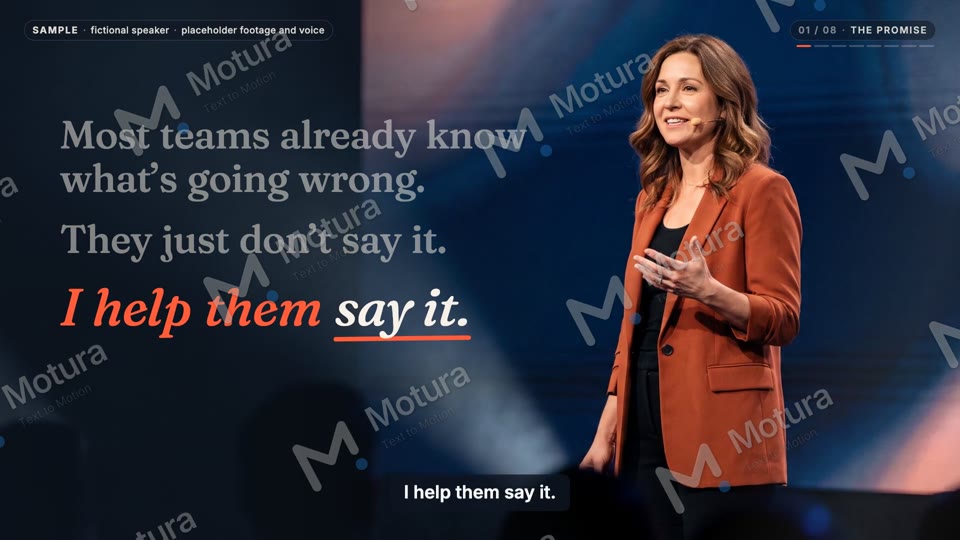
The problem this keynote is about: teams know what is going wrong and don’t say it. One second later the promise is complete: “I help them say it.”
On screen: her own words, building line by line on a main stage.
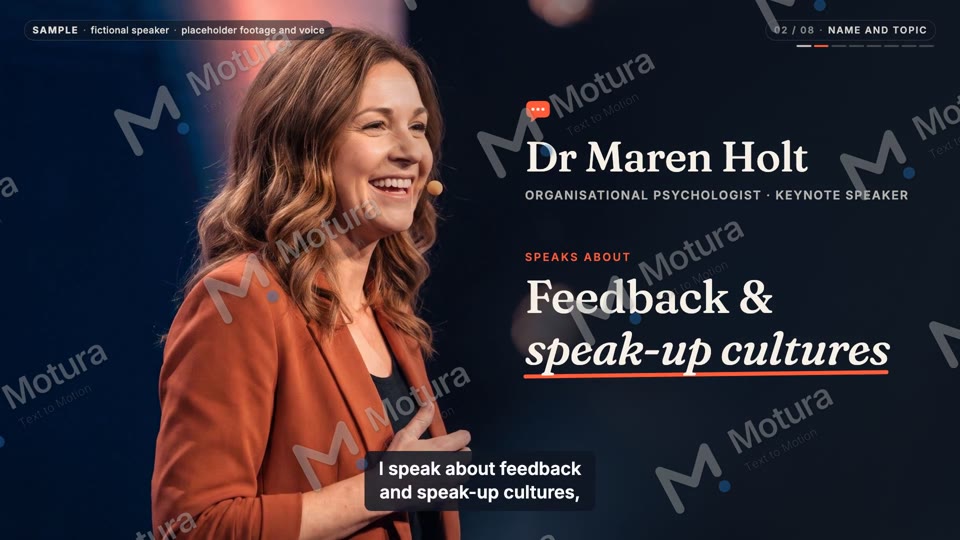
Her name, her profession, the keynote topic in four words, and the first audience: leadership teams. HR follows a moment later.
On screen: name and title, then “Feedback & speak-up cultures”.
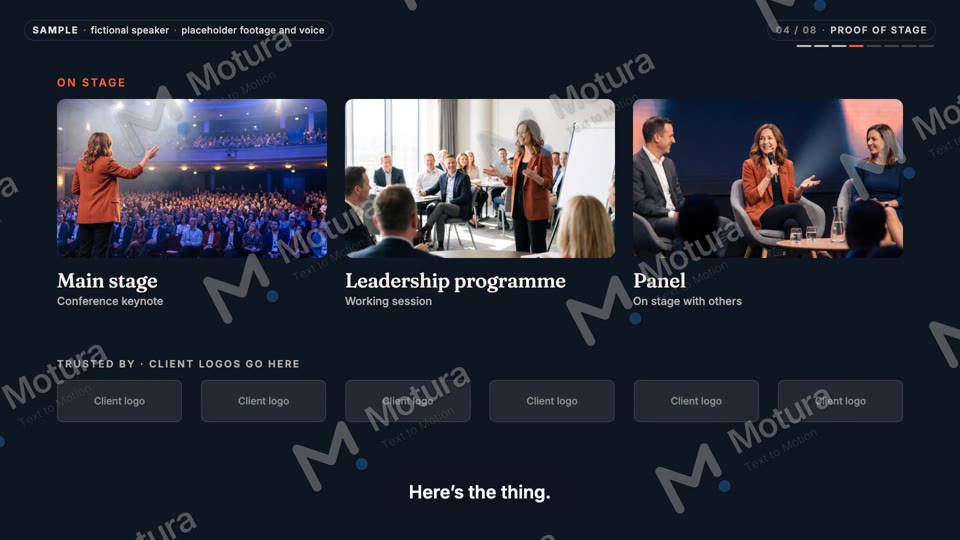
She plays main stages, leadership programmes and panels, and there is a row for client logos. And they are inside the first idea, so they know how the talk sounds.
On screen: a full auditorium, three stages, the logo row, the first key phrase.
Eight beats in 57 seconds. In the 2 to 3 minute main reel the same order holds, with more room for idea moments, testimonials and stage footage.
0:00 The promiseThe speaker’s own sentence, word by word with the voice, over the biggest stage. No mood montage first.
0:07 Name and topicWho she is and the topic by name: feedback and speak-up cultures.
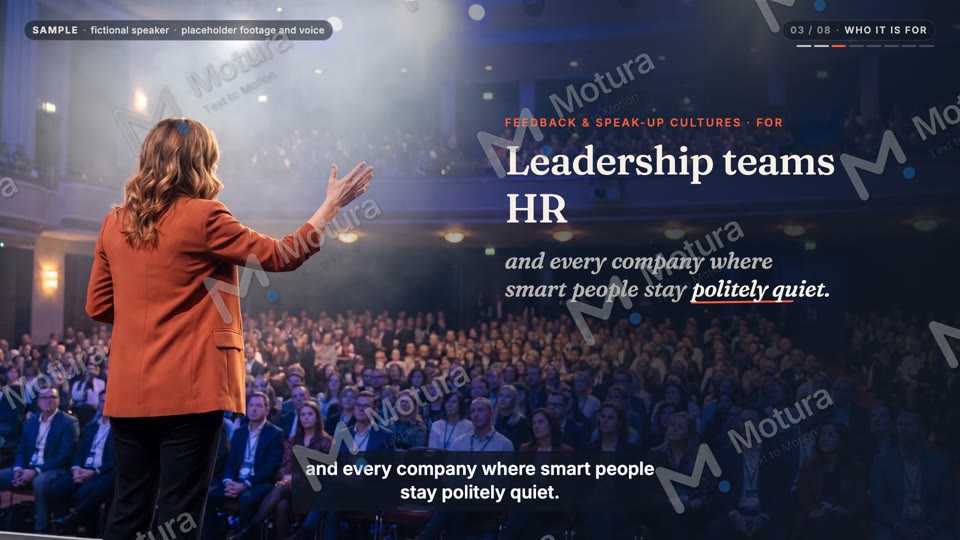
0:14 Who it is forLeadership teams, HR, and a line every booker recognises from their own company.
0:20 Proof of stageMain stage, leadership programme, panel, and the row where your client logos go.
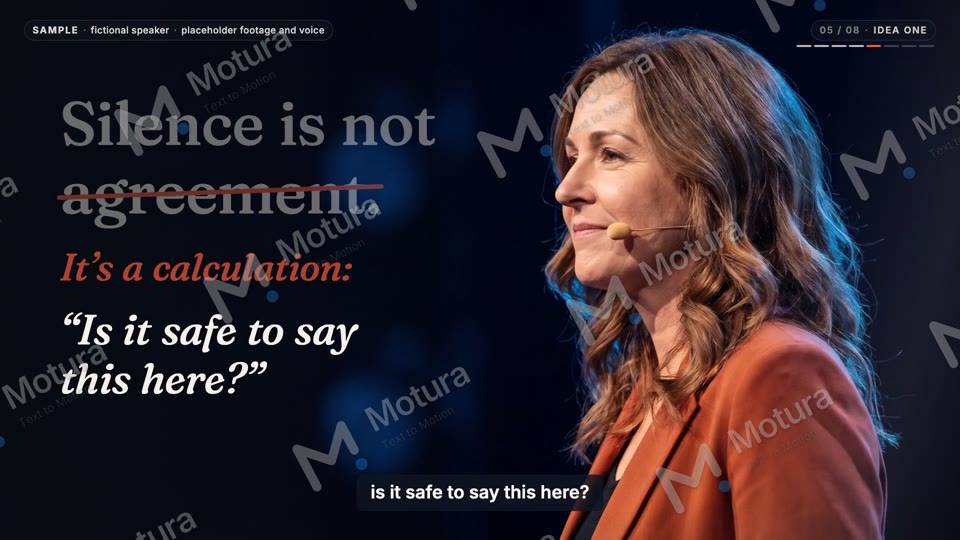
0:25 Idea oneOne sharp thought on feedback, with the key phrase animated as she says it.
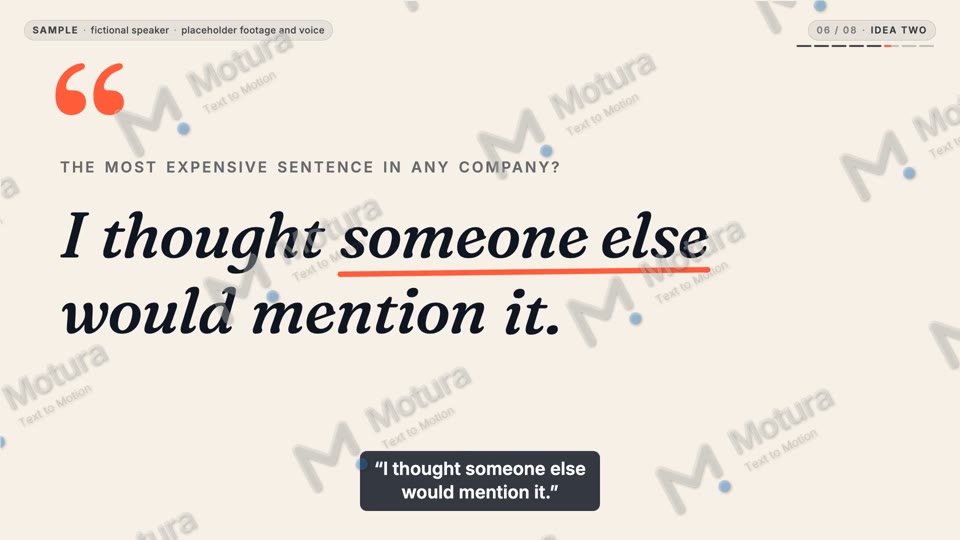
0:32 Idea twoA line people repeat afterwards, then the room’s reaction and the answer.
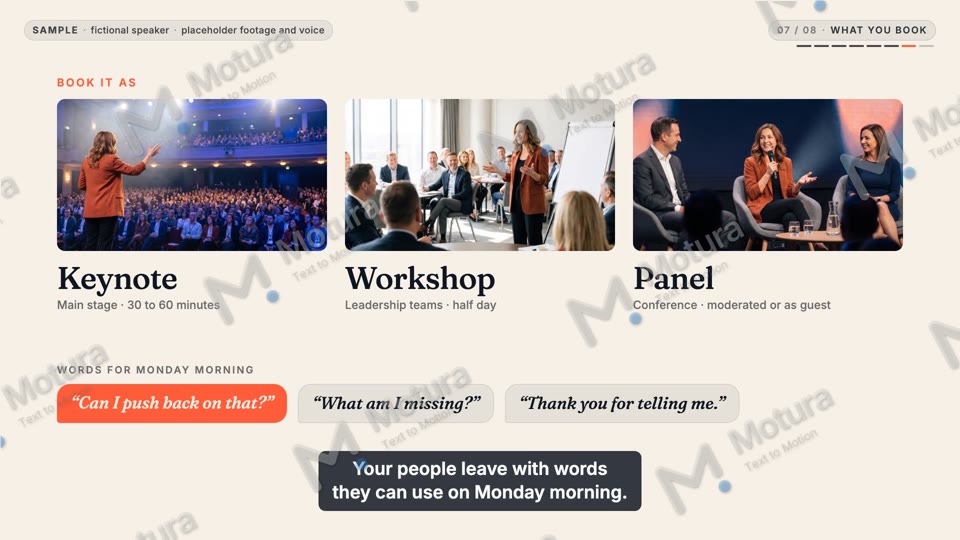
0:44 What you bookKeynote, workshop, panel, and what people take back to work.
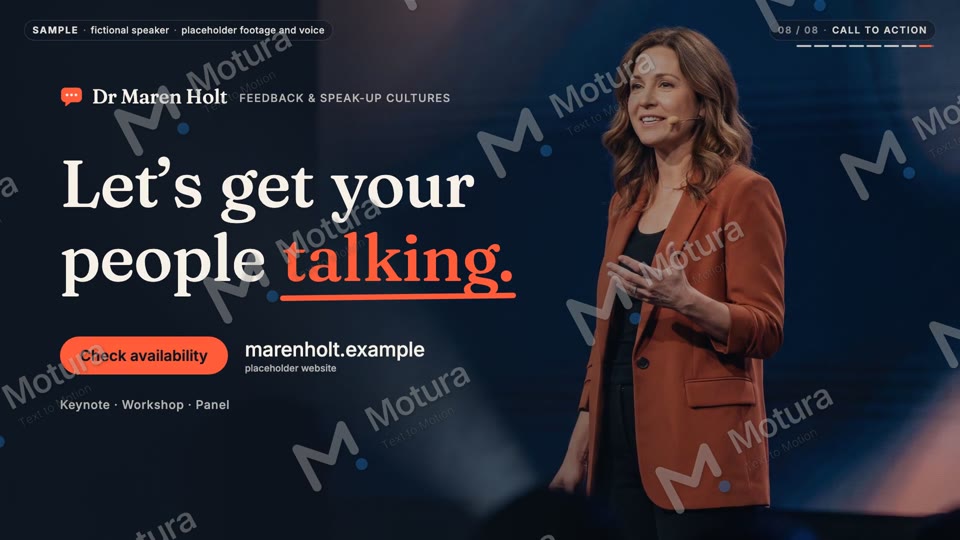
0:52 Call to actionOne sentence, one button, the website. The bureau version ends here without contact details.
18 seconds for the top of the website. It plays muted and needs no speech, no music and no subtitles: the topic, the promise and the stage level come from the picture and big type alone. The last frame leads straight back into the first.
Playing muted on a loop right now, the way it would on the new site.
You said there is little footage of you talking about feedback. This is what I would ask you to record, and which gap in the edit each shot fills. The lines are drafts until I have seen your footage and heard how you say things.
All setups: 4K, frame rate matched to the stage footage, 50 fps for B-roll. Lavalier plus boom microphone. 30 seconds of room tone per setup. Same outfit family as on stage, no fine patterns.
| # | Type | What we record | Setup | Gap it fills in the edit |
|---|---|---|---|---|
| 1 | To camera | The promise in one sentence, three variations. Draft: “Most teams already know what’s going wrong. They just don’t say it. I help them say it.” | A | Seconds 0 to 8. No stage clip states the promise in one sentence. |
| 2 | To camera | Name, profession and the topic by name. Draft: “I’m [name], organisational psychologist. I speak about feedback and speak-up cultures.” | A | Seconds 8 to 15. The stage footage never says the new topic by name. |
| 3 | To camera | Who it is for. Draft: “For leadership teams, HR, and every company where smart people stay politely quiet.” | A | Seconds 10 to 20. A booker recognises their own audience. |
| 4 | To camera | Idea one in your own words, 15 to 20 seconds. Draft opening: “Silence is not agreement. It’s a calculation: is it safe to say this here?” | B | The gap named in the brief: little footage of you talking about feedback. |
| 5 | To camera | Idea two as a short story from real work, 20 to 25 seconds: the situation, what nobody said, what changed. | B | Second idea moment in the main reel. The story also carries the 60-second cut. |
| 6 | To camera | What a client books: keynote, workshop, panel, and what people can do the next morning. | B | The “what you book” section before the call to action. |
| 7 | To camera | Call to action in two versions: with website and contact (main reel), and without any contact details (bureau version). Hold for 3 seconds after the last word. | A, then C | Clean endings for both versions. Nothing has to be blurred or cut off later. |
| 8 | To camera | Four one-line bridges, for example “Here’s the thing.” and “This is where feedback comes in.” | B | Joins stage clips from different events without a hard jump. |
| 9 | Voice-over | All lines above again as voice only, plus six short lines to sit over stage footage. Same microphone, close, then 30 seconds of room tone. | Booth or quiet studio | The best stage pictures keep running while the voice keeps selling. Room tone hides the edits. |
| 10 | B-roll | Hands and gestures, the clicker, notes with handwritten key phrases, putting on the headset microphone, a real laugh between takes. | A, 85 to 100 mm feel, 50 fps | Covers cuts inside studio statements and podcast audio. |
| 11 | B-roll, silent | Walk into the light, stop, look to camera, smile. Turn from profile to camera. Listening, then laughing. No speech needed. | C, 50 fps | The silent website loop and the first seconds of the 60-second cut. |
| 12 | Stills | Three portraits per setup in the same light. | A, B, C | Poster frames, thumbnails and end cards. |
| Time | Picture | Sound | What the booker knows now |
|---|---|---|---|
| 0:00 to 0:05 | Your strongest stage shot, wide then close, you mid-sentence. The promise as one key phrase on screen. | Your own voice: the promise in one sentence (studio line 1, or stage audio if a clip says it). | The topic: people don’t speak up, and you change that. And a big stage, seen before it is claimed. |
| 0:05 to 0:12 | Second stage. Name and profession as a lower third, then the title “Feedback & speak-up cultures”. | Studio line 2: name, profession, topic by name. | Who you are and what the keynote is about, in your words. |
| 0:12 to 0:18 | Three fast stage shots with audience reactions. Three short audience labels. | Studio line 3: who it is for. Music stays low. | Whether this is for their audience: leadership teams, HR, their company. |
| 0:18 to 0:23 | Stage montage with the real event names as lower thirds, then your client logos (as supplied). | Music opens up for two seconds, real applause or laughter from the room. | Stage level: serious stages and known clients. |
| 0:23 to 0:30 | First idea moment: your best eight seconds on feedback, from stage or studio. Key phrase animated. | Your live voice, room tone left in, music ducked. | How the talk feels: clear, warm, a bit fun. They want to see the rest. |
Until I see the footage, the lines are drafts and the timings are targets. The order is the point: promise, topic by name, audience, stage level, first idea. If a booker stops watching at 0:30, they can already recommend you.
Six deliverables from your post, and how each one is built. The versions are planned before the shoot, so none of them is a compromise made at export.
The full structure: promise, topic, audience, stages, idea moments, testimonials, formats, and the call to action with website and contact.
No website and no personal contact details anywhere. The ending is recorded for it in the studio (shot list row 7), not blurred afterwards.
Cut again from the start, not just shortened: hook first, one idea, stage proof, call to action. Subtitles burned in.
Works without speech, music or subtitles: picture and big type only. First and last frame match, so the loop has no jump.
English subtitles in your brand type on the main reel and the short cut, timed to the words, plus matching .srt files.
4K masters where the source holds up, HD where it does not, web versions, project files, and music and stock licences in your name.
Stage recordings, podcast audio and a studio voice-over have to sound like one person in one film. The same goes for the pictures.
Your dates, in four steps.
I log every clip, pick the strongest stage moments, and write the script and the studio shot list around what is missing.
You record the lines, the voice-over and the B-roll from the list. It is written so the studio team can run it as it is.
The main reel with subtitles, the mix and the grade at draft level, plus first versions of the short cut and the loop.
Two revision rounds, then all versions, .srt files, masters, project files and licences.